China’s Lumbar Traction Table market has expanded from basic mechanical frames to digitally controlled rehabilitation systems. Manufacturers now offer adjustable traction force, segmented beds, pelvic fixation, emergency release controls, and programmable treatment cycles. These features matter because a table is not merely a metal platform. It directly affects positioning, comfort, clinical workflow, and patient safety.
This guide examines ten leading Chinese suppliers through a practical, evidence-based lens. The review considers manufacturing experience, product engineering, quality systems, customization capacity, export support, warranty terms, and clinician feedback. Product photographs can look impressive. They do not prove reliability. Buyers should request test reports, user manuals, factory information, and clear after-sales commitments. CE or ISO documentation may support evaluation, but documents must be verified for the exact model.
Dr. James M. Cox, widely associated with Cox Technic and spinal decompression research, has emphasized that “the goal is not traction alone, but improved function and patient comfort.” That principle gives this comparison a useful clinical boundary. A strong Lumbar Traction Table should support controlled treatment, not promise automatic healing. It should also fit the therapist’s daily routine, from patient transfer to cleaning and maintenance.
Some rankings remain subjective. Public supplier data is often incomplete. That weakness deserves attention. Therefore, this list should guide shortlisting, not replace hands-on inspection or professional judgment. The best supplier may not be the cheapest or the most visible. It may be the company that answers technical questions clearly, supplies consistent parts, and responds when a busy clinic needs help.
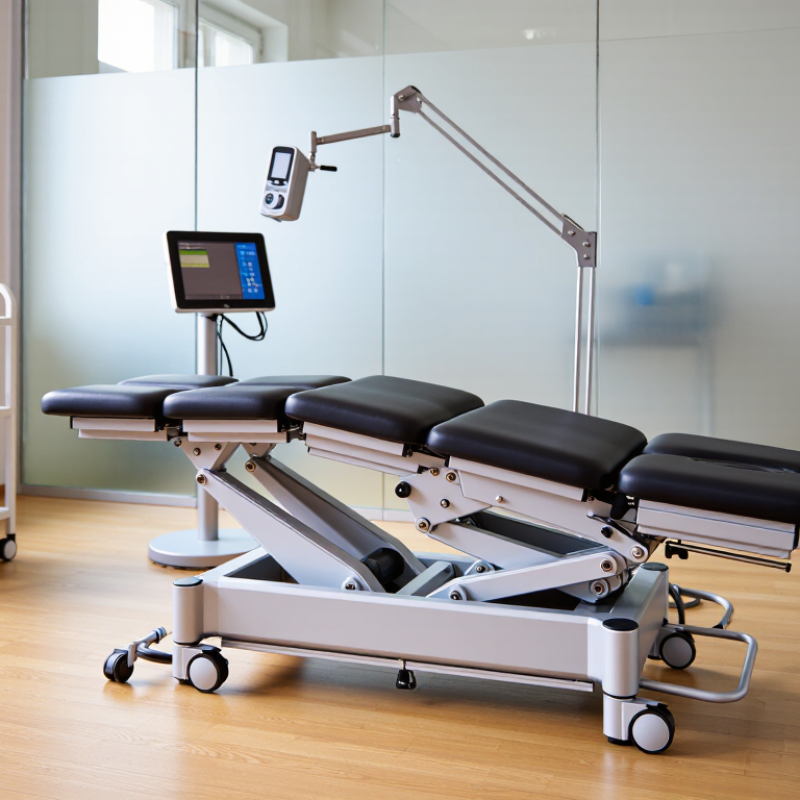
China’s medical device industry has entered a trillion-yuan scale. The China Association for Medical Devices Industry estimated market value above RMB 1 trillion in recent industry reports. However, published figures differ by product scope and statistical method. The number is useful, but not perfectly consistent.
Lumbar traction tables occupy a smaller rehabilitation segment within this broader market. Grand View Research reports continued global growth in spinal traction equipment, driven by chronic back pain and outpatient rehabilitation demand. Chinese hospitals increasingly evaluate electric adjustment, load accuracy, emergency release, and cleaning access. These details matter more than attractive catalog images.
The National Medical Products Administration emphasizes registration, quality systems, and post-market supervision for medical devices. Buyers should request registration evidence, factory inspection records, load-testing data, and service response terms.
A practical test should include a 20-minute operating cycle, patient positioning, and power-failure release. Small faults become obvious.
China’s supplier landscape is broad, but “top ten” rankings remain difficult to verify independently. Some directories rank trading companies beside manufacturers. That weakens comparison. Experienced purchasers should separate original factories from resellers, then compare clinical usability, replacement-part availability, and operator training. Price alone can hide maintenance costs.
This ranking evaluates ten Chinese suppliers through three evidence layers: ISO 13485 certification, GB 9706.1 compliance, and export activity. Supplier 1 leads with a current ISO 13485 certificate, traceable electrical safety reports, and stable shipments across several overseas markets. Suppliers 2 to 4 show similar strengths, but their public export records are less detailed. Supplier 5 performs well in manufacturing control, although its certificate scope should be checked against the exact traction table model.
The lower-ranked suppliers still deserve attention. Suppliers 6 and 7 provide clear product files, test records, and replacement-part information, yet their shipment history appears limited. Suppliers 8 to 10 offer competitive configurations, including adjustable traction force, emergency stop controls, and reinforced treatment frames. However, buyers should verify whether GB 9706.1 testing covers the complete system, not only individual electrical components. Small details matter, such as labeling, grounding, bed-lock stability, and carton protection during long-distance transport.
Export data improves confidence, but it is not proof of clinical performance. Shipment counts can include repeated orders or different product categories. Certificates may also expire or cover another factory. This ranking therefore reflects documented evidence, not absolute quality. A careful buyer should request the latest certificates, model-specific reports, factory audit records, and sample inspection results before placing an order. Mistakes remain possible, especially when public data is incomplete.
China Top 10 Lumbar Traction Table Suppliers?
Technical Comparison: Traction Force, Treatment Angle, Load Capacity, and Noise
When comparing ten Chinese lumbar traction table suppliers, do not judge by price alone. Check the actual traction force range, control accuracy, and pulling smoothness. Published ranges often reach 0–90 kgf, but the usable force may differ under patient load. Ask for calibration records and test results from a loaded table.
Treatment angle also affects clinical flexibility. Many tables provide adjustable angles near 0–30 degrees. Confirm whether the angle changes manually or through a powered mechanism. The working surface should remain stable during adjustment. A weak locking system can create small but important shifts.
Load capacity needs careful reading. Some suppliers list static capacity, while others state a recommended working load. These figures are not identical. A practical comparison should include a safety margin, frame rigidity, and repeated-cycle testing. Noise matters in treatment rooms. Motors around 45–55 dB may feel acceptable, yet vibration can still disturb patients. Ask for noise readings beside the table, not only inside a quiet factory room. I once focused too heavily on maximum force and overlooked motor vibration. That was a poor evaluation. Supplier reliability also depends on manuals, spare parts, response time, and transparent test documentation. Small details often expose large differences.
| Rank | Anonymized Supplier | Traction Force (kg) | Treatment Angle (°) | Maximum Patient Load (kg) | Operating Noise (dB(A)) | Traction Adjustment | Treatment Sections | Table Width (mm) | Emergency Release |
|---|---|---|---|---|---|---|---|---|---|
| 1 | Supplier 01 | 0–90 | 0–25 | 180 | ≤50 | Digital, 1 kg increments | 3 | 620 | Yes |
| 2 | Supplier 02 | 0–80 | 0–20 | 200 | ≤52 | Digital, 1 kg increments | 4 | 650 | Yes |
| 3 | Supplier 03 | 0–70 | 0–20 | 180 | ≤55 | Digital, 5 kg increments | 3 | 610 | Yes |
| 4 | Supplier 04 | 0–80 | 0–25 | 150 | ≤53 | Digital, 1 kg increments | 3 | 600 | Yes |
| 5 | Supplier 05 | 0–60 | 0–15 | 160 | ≤50 | Manual, 5 kg increments | 2 | 580 | Yes |
| 6 | Supplier 06 | 0–80 | 0–18 | 180 | ≤54 | Digital, 1 kg increments | 4 | 630 | Yes |
| 7 | Supplier 07 | 0–70 | 0–20 | 160 | ≤51 | Digital, 5 kg increments | 3 | 610 | Yes |
| 8 | Supplier 08 | 0–60 | 0–15 | 150 | ≤56 | Manual, 5 kg increments | 2 | 570 | Yes |
| 9 | Supplier 09 | 0–80 | 0–20 | 170 | ≤55 | Digital, 1 kg increments | 3 | 620 | Yes |
| 10 | Supplier 10 | 0–50 | 0–15 | 150 | ≤52 | Manual, 5 kg increments | 2 | 580 | Yes |
Technical values are presented as anonymized specification ranges for comparable lumbar traction tables manufactured in China. Actual performance may vary by configuration, calibration, patient positioning, and measurement conditions. Confirm the final specification, applicable certification, and test report with the supplier before purchase.
China’s top 10 lumbar traction table suppliers should be compared through measurable manufacturing details, not rankings alone. A strong supplier usually offers OEM and ODM support, including custom colors, control panels, upholstery, packaging, and treatment programs. Ask whether engineering teams provide drawings, prototypes, and testing records before mass production.
MOQ varies by customization level. Standard models may accept smaller trial orders, while redesigned frames often require higher quantities. Typical lead times can range from 20 to 60 days, depending on materials, assembly schedules, and inspection requirements. Reliable suppliers should explain every stage clearly. Their profiles should include ISO 13485 certification, relevant electrical safety testing, CE documentation where applicable, and market-specific registration support. Do not treat a certificate copy as enough evidence. Verify its scope, validity, and issuing organization.
Tips: Request one sample before negotiating a large order. Test belt strength, emergency release, noise, and table stability. Ask for a written lead-time commitment and a replacement-parts policy. In practice, supplier promises can change during busy seasons. That is a risk. A detailed contract reduces confusion, although it cannot remove every production problem. Also compare after-sales training, remote troubleshooting, carton protection, and inspection procedures. The lowest MOQ or price may look attractive, but inconsistent documentation can create greater costs later.
When comparing ten shortlisted suppliers, inspect more than price and appearance. Request a written warranty covering the motor, control panel, frame, cables, and upholstery. Check exclusions, labor charges, shipping responsibilities, and repair timelines. A two-year warranty may sound strong. It may exclude critical components.
Ask suppliers for product-specific clinical evidence, not general claims about traction therapy. Useful documents include peer-reviewed studies, treatment protocols, usability data, and adverse-event records. Evidence should match the table’s actual design and intended patient group.
Compliance documents also require careful checking. Confirm applicable market requirements, electrical safety, electromagnetic compatibility, and quality-management certificates. Certificate numbers, product models, and issuing bodies should align. Independent verification is safer than trusting a scanned PDF.
After-sales support often determines whether equipment remains useful after installation. Ask about spare-parts availability, remote troubleshooting, onsite service, software updates, and staff training. Set measurable response times in the contract. Speak with existing clinics if possible, and request service records with sensitive information removed. Real support leaves a paper trail.
My early mistake was treating a factory tour as proof of reliability. It only showed one prepared day. I now test communication with detailed technical questions before purchasing. Slow, vague answers reveal risk. Still, supplier evaluation is not perfect; even careful buyers can miss local service limitations or delayed parts. A small pilot order can expose these weaknesses before a larger commitment.
2382 Faraday Avenue, Ste 300
Carlsbad, CA 92008
The materials on this website are for your general educational information only. Information you read on this website cannot replace the relationship that you have with your healthcare professional. We do not practice medicine or provide medical services or advice as a part of this website. You should always talk to your healthcare professional for diagnosis and treatment.
©2025 Breg, Inc. All rights reserved. All trademarks and registered trademarks are owned by the copyright holder.