Choosing the right knee immobilizer can feel simple until pain, swelling, or limited movement complicates the decision. A brace that looks supportive may still fit poorly, restrict circulation, or fail to protect the injured area. The correct choice depends on the injury, treatment plan, body shape, and required level of movement.
A knee immobilizer usually holds the leg in a stable, extended position. Doctors may recommend one after certain injuries, procedures, or periods of severe instability. However, it is not automatically suitable for every knee problem. A trained healthcare professional should assess the knee before prolonged use. Their guidance matters, especially when swelling changes throughout the day.
Look closely at the brace.
Measure the thigh and calf according to the manufacturer’s instructions. Check whether the straps stay secure without creating pressure points. The back panel should support the leg, while the edges should not dig into the skin. Walking across a room can reveal slipping that appears invisible while sitting. Skin color, numbness, increasing pain, or cold toes require prompt attention.
Material and comfort also influence real-world use. Breathable fabric may reduce sweating, but it cannot solve every fitting problem. Some patients need adjustable supports, while others require a custom device. It is easy to focus on price or appearance. That choice may be shortsighted. This guide explains key features, fitting questions, safety considerations, and common mistakes, while recognizing that online advice cannot replace an individual clinical evaluation.
How to Choose the Right Knee Immobilizer?
Define the injury before choosing an immobilizer. The Ottawa Knee Rule helps assess acute knee trauma and has reported sensitivity near 98% for detecting fractures. It considers age, patellar tenderness, fibular-head tenderness, limited flexion, and inability to take four steps. This tool supports clinical decisions, but it does not replace examination or imaging. It also may not apply well to children, chronic pain, altered sensation, or unusual injuries.
A knee immobilizer may be suitable when a fracture, dislocation, or serious extensor mechanism injury is suspected. It keeps the joint straight and can reduce painful movement during transport. However, prolonged use may increase stiffness, swelling, and muscle weakness. In practice, fitting errors are common. A device that is too loose can slip, while excessive pressure may cause numbness or skin damage. Check circulation, sensation, and toe movement after fitting.
Tips: Measure the thigh and calf, then compare the size guide with the patient’s leg. Keep the kneecap centered and avoid folding the straps behind the knee. Inspect the skin after several hours. Seek urgent medical care for deformity, cold toes, worsening numbness, or severe swelling. A negative Ottawa Knee Rule does not explain every painful knee, and that limitation deserves attention.

How to Choose the Right Knee Immobilizer?
The correct flexion setting depends on the injury, surgery, and prescribed healing position. A 0° setting keeps the knee straight and limits movement most firmly. It may suit early protection after certain procedures or serious ligament injuries. A 15° setting allows slight bending while still reducing strain. A 30° setting offers more comfort for swelling, sitting, or controlled rehabilitation. However, more movement is not automatically better. The safest angle must come from a qualified clinician who understands the patient’s diagnosis.
A careful fitting check matters. The brace should sit above and below the kneecap without pressing directly on it. Straps should feel secure, not numbingly tight. Check the skin after walking for ten minutes. Red marks that remain may indicate poor adjustment. A common mistake is choosing 30° because it feels comfortable. Comfort can hide unwanted motion. The right decision is sometimes less comfortable.
Tips: Confirm the prescribed angle before wearing the immobilizer. Do not change the setting independently. Keep the hinge aligned with the knee joint. Watch for increasing pain, cold toes, unusual swelling, or skin color changes. Contact a healthcare professional if these signs appear. Small fitting details matter.
A 0° setting holds the knee in full extension, while 15° and 30° settings permit progressively greater knee flexion. These values describe the brace’s mechanical range setting, not a clinical outcome; the appropriate setting should follow a qualified clinician’s instructions.
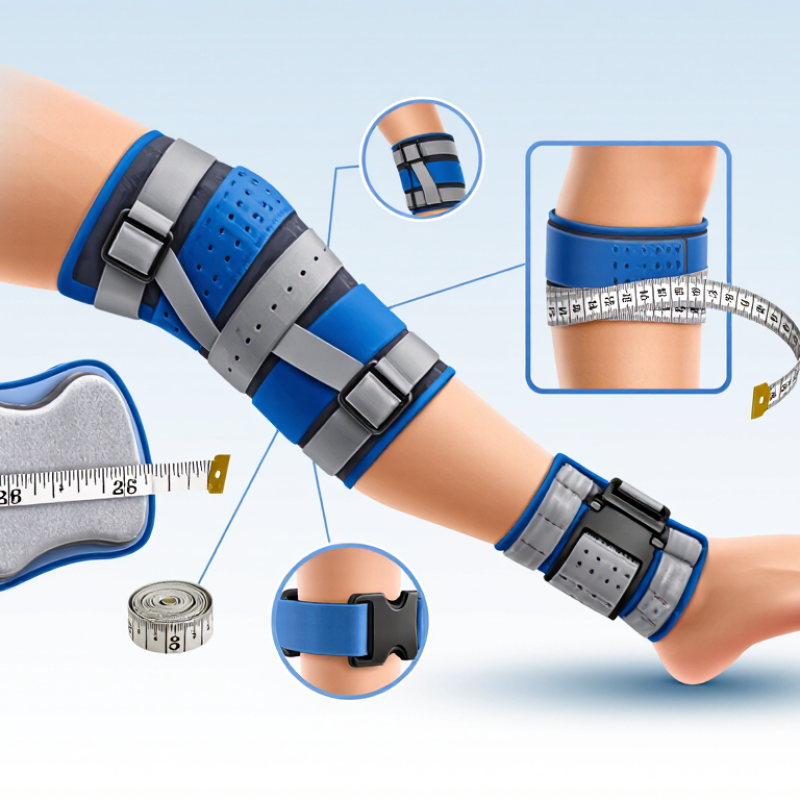
Knee support starts with accurate measurement, not guesswork. The World Health Organization reported 528 million people lived with osteoarthritis in 2019, with the knee commonly affected. A correctly fitted immobilizer can improve stability and reduce unwanted movement during recovery. Measure the thigh at the chart’s specified point, often several centimeters above the kneecap. Measure the calf at its widest area. Keep the tape level and snug, not tight. Record both measurements in centimeters.
Follow the thigh and calf circumference charts carefully. Do not select a size using knee circumference alone. A person may have a narrow knee but a fuller thigh or calf. That mismatch can cause slipping, pressure marks, or restricted circulation.
Measure over light clothing, and repeat each measurement once. Charts differ between designs, so never transfer a size from another product. In clinical practice, borderline measurements deserve extra attention. The larger size is not always safer.
Tips: Measure at the same time of day, preferably after swelling has settled. Check the skin after ten minutes of wear. Redness that remains, numbness, cold toes, or increasing pain needs professional review. Do not cut or reshape the immobilizer yourself. A clinician should confirm the fit when swelling changes, after surgery, or when the chart ranges overlap. Small errors matter.
How to Choose the Right Knee Immobilizer?
A secure knee immobilizer should feel supportive, not painfully tight. In clinical practice, fit must be checked again after walking, sitting, and swelling changes. The brace should hold the knee in its prescribed position without pressing sharply behind the calf. Place two fingers beneath each strap when possible. That test is useful, but imperfect.
Inspect the skin after 15 to 30 minutes, then again after removal. Look for redness, blisters, warmth, dampness, or pale patches. Redness that remains after several minutes needs professional review. The Agency for Healthcare Research and Quality reports that about 2.5 million hospital patients develop pressure injuries annually in the United States. A brace can create a smaller, hidden pressure point.
Check circulation by comparing both feet. Note color, temperature, swelling, and capillary refill. Ask about numbness, tingling, burning, or unusual weakness. Then ask the person to move the toes and ankle, unless movement is medically restricted. NICE guidance recommends documented neurovascular observations after limb injury and immobilization. Do not ignore vague discomfort. It may be the earliest warning. A loose brace can also fail. Recheck after every adjustment, because swelling rarely follows a perfect schedule. If the foot becomes cold, blue, increasingly numb, or difficult to move, remove pressure and seek urgent clinical advice.
Use this checklist to confirm that a knee immobilizer is appropriately positioned and not causing avoidable pressure or neurovascular problems. Follow the instructions provided by a qualified healthcare professional.
| Safety Dimension | What to Check | Expected Finding | Warning Signs | Recommended Action |
|---|---|---|---|---|
| Overall fit and alignment | Confirm that the immobilizer is centered on the leg, supports the knee as intended, and follows the prescribed position. | The brace feels secure without excessive tightness, slipping, folding, or pressing sharply against the leg. | Repeated slipping, severe pressure, pinching, wrinkled padding, or a brace that cannot be fastened without excessive force. | Stop and reposition it according to the fitting instructions. Ask a clinician to reassess the size or design if the problem persists. |
| Strap tension | Check each strap and the padding around the thigh, knee, and lower leg. The brace should be stable but should not restrict blood flow. | Straps remain secure during normal transfers or walking as permitted, with no new numbness, color change, or increasing pain. | Toes become pale, blue, unusually cold, increasingly swollen, or painful after tightening the brace. | Loosen the straps if instructed and recheck the leg promptly. Seek urgent medical advice if circulation does not quickly return to normal or symptoms are severe. |
| Skin condition | Inspect the skin under and around the brace, especially the kneecap, back of the knee, ankle, heel, bony areas, and strap edges. | Skin is intact, dry, and close to its usual color, without persistent redness, blistering, open areas, drainage, or pressure marks. | Redness that does not fade after pressure is removed, blistering, broken skin, increasing warmth, drainage, or rapidly worsening pain. | Remove or adjust the immobilizer only as permitted by the care plan, protect the area, and contact a healthcare professional. Do not place extra padding that changes the prescribed fit without advice. |
| Circulation | Compare both legs when possible. Check toe color, temperature, swelling, and whether the foot appears markedly different from the other side. | Toes remain their usual color and warmth, swelling is not rapidly increasing, and there is no new severe tightness or throbbing pain. | New or worsening swelling, marked color change, a cold foot, severe pain out of proportion, or symptoms that do not improve after the brace is loosened as directed. | Treat persistent or severe changes as urgent. Contact emergency services for a cold, blue, or severely painful foot, especially with sudden onset. |
| Sensation | Ask whether there is new numbness, tingling, burning, or reduced feeling in the foot, toes, or lower leg. | Sensation is unchanged from baseline and is similar on both sides, unless a clinician has documented a pre-existing difference. | New or progressive numbness, pins and needles, burning, or loss of feeling after the immobilizer is applied. | Check the strap position and contact the treating clinician promptly. Seek urgent help if sensation loss is sudden, severe, or accompanied by weakness or color change. |
| Movement and strength | Check only the movements allowed by the treatment plan, such as gentle toe movement or ankle movement if permitted. Do not force the knee. | Permitted movements remain possible without new weakness, inability to move the toes, or a sudden increase in pain. | New inability to move the toes or ankle, marked weakness, worsening pain, or movement that causes the immobilizer to shift dangerously. | Keep the knee in the prescribed position and seek prompt medical assessment. Do not test or force unapproved knee movement. |
| Pain and comfort | Compare pain before and after application and after changes in position. Check for focal pressure at the brace edges or hinges, if present. | The immobilizer provides support without causing new focal pain, increasing throbbing, or progressive discomfort. | Pain steadily increases, becomes concentrated under a strap or edge, or is not relieved by prescribed measures. | Recheck alignment and strap tension. Contact the clinician if pain continues, becomes severe, or is different from the expected injury-related pain. |
| Recheck timing | Recheck the skin, circulation, sensation, and permitted movement after initial fitting, after readjustment, after position changes, and during routine use. | Findings remain stable and match the person’s normal baseline or the clinician’s documented expectations. | Symptoms appear after the brace has been worn for a period of time or recur whenever the straps are tightened. | Follow the healthcare professional’s schedule. If no schedule was provided, ask when and how often the immobilizer should be removed for inspection. |
| Hygiene and moisture | Keep the skin and padding clean and dry. Inspect after sweating, bathing, or accidental wetting. | No persistent moisture, odor, macerated skin, or damp padding that increases friction. | Wet or soiled padding, softening skin, rash, or irritation that worsens with continued use. | Follow the manufacturer’s or clinician’s cleaning instructions. Do not use heat to dry the brace unless specifically approved. |
How to Choose the Right Knee Immobilizer?
An immobilizer should support the injury without extending recovery unnecessarily. The correct choice depends on the clinician’s diagnosis, prescribed angle, and expected treatment period. A device should feel secure, but it should not create numbness, sharp pressure, or excessive swelling. Check the skin around the thigh, knee, and calf each day. Red marks that remain after removal deserve professional attention.
Follow-up planning matters as much as the initial fitting. Ask when the next appointment should occur, and write the date down. During review, the clinician may assess pain, swelling, circulation, skin condition, and knee stability. They may also adjust the brace or begin controlled movement. Do not extend immobilization independently because the knee feels vulnerable. Prolonged restriction can contribute to stiffness, muscle weakness, and slower functional recovery. The plan may change.
Small details can improve adherence. Choose a design that allows the prescribed dressing changes and fits over expected clothing. Fasten the straps evenly, checking them after walking or resting. A good fit can still feel awkward. That discomfort should prompt reflection, not silent endurance. Contact the care team if the brace slips, causes persistent tingling, or makes movement unsafe. Seek urgent medical assessment for severe pain, a cold or discolored foot, sudden calf swelling, or breathing difficulty. Keep every follow-up appointment, even when symptoms improve.
2382 Faraday Avenue, Ste 300
Carlsbad, CA 92008
The materials on this website are for your general educational information only. Information you read on this website cannot replace the relationship that you have with your healthcare professional. We do not practice medicine or provide medical services or advice as a part of this website. You should always talk to your healthcare professional for diagnosis and treatment.
©2025 Breg, Inc. All rights reserved. All trademarks and registered trademarks are owned by the copyright holder.